

Beach beasts of irrational optimism
How do we hold onto a sense of possibility in an age of systemic complexity? An exploration at the intersection of low-tech ingenuity, art, biology, and engineering

“The world needs a great deal of innovation to survive.” — Theo Jansen
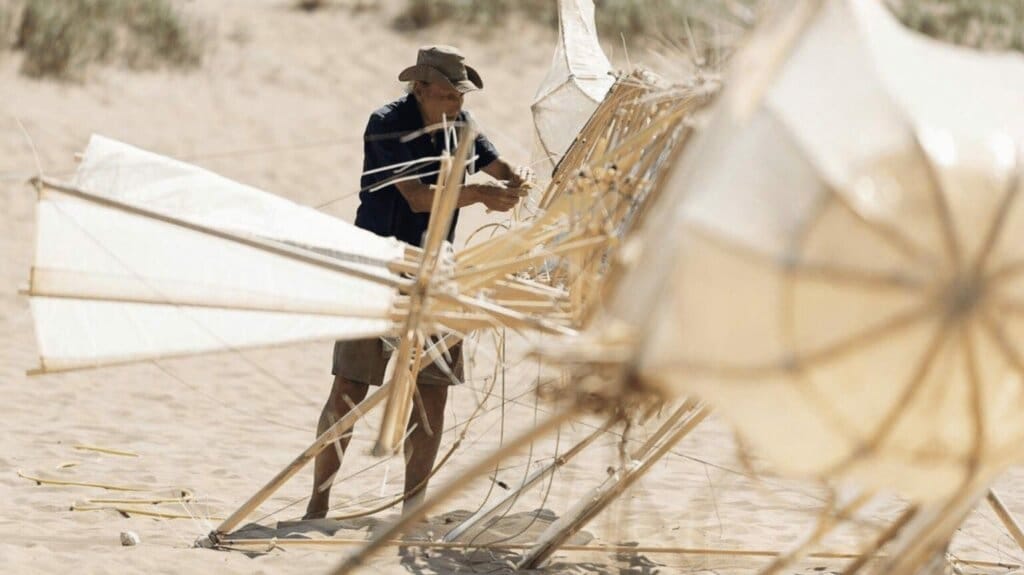
Dutch artist and inventor Theo Jansen’s Strandbeests (Beach beasts) are wind-powered kinetic sculptures that blur the line between biology, art and engineering. Constructed from “low-tech” materials like PVC pipes and tie wraps, these complex structures use algorithmic mechanisms to walk, sail, sense obstacles, store energy, and have even evolved to fly.
Strandbeest Evolution 2025 provides an update on the evolutionary development, which is going on since 1990 (Video © strandbeests.com)
From 1986 to 2008, Theo Jansen wrote columns for a Dutch national newspaper - De Volkskrant. In 1990, he introduced the concept in an article titled Strandlopers ('Beach Walkers'), reflecting on the threat of climate change driven rising sea levels along the Dutch coast—a terrain constantly reshaped by wind and sand. He envisioned wind-powered skeletal creatures that could traverse the beaches, migrating sand back toward the dunes to combat erosion.
He wrote, “There really ought to be creatures that permanently loosen a lot of sand on the beach and then throw it into the air so that it blows towards the dunes.” The animals would have to be made of electrical conduit and draw their energy from the wind: “so they don’t need to eat.”
Months after the article was published he started building Animaris Vulgaris; one of the first Strandbeests. He’s been building new evolutions of beasts ever since.
Jansen’s vision resonates deeply in the Netherlands, where roughly a third of the country lies below sea level. Over centuries, the Dutch have reclaimed vast areas of land through the creation of polders and an extensive system of dikes. With 280 miles of low-lying coastline bordering the North Sea, the country has long been in constant battle with the elements—requiring the Dutch to be highly resourceful in working with climatic conditions.
Portrait of Theo Jansen by Aron Suveg
More than just art, the Strandbeests embody Jansen’s belief in ingenuity as a response to looming challenges—like rising sea levels—showing how creativity can transform adversity into something alive, purposeful, and full of possibility.
In the piece below,
Jansen describes his own motivation as ‘irrational optimism’—the belief that we can always devise a solution—which he calls “a lifeline for humanity.” As Jansen puts it, “That’s why I have no fear that the world will perish.”
The man who made the wind walk
By Jurjen Slump
The latest generation of strandbeests is no longer showing any sign of life. Since mid-September they have been standing motionless on the beach at Scheveningen, just to the north of the Zwarte Pad. They are buried under half a metre of sand, the result of this year’s first autumn storm. A short distance away, an excavator is digging out the beach bar Het Puntje.
Theo Jansen isn’t saddened by it. He regards the storm as a necessary accident, part of the ‘evolutionary process’ of his strandbeests. The artist points to a broken tube. “Thanks to the storm I know that I made the mistake of not attaching the tube to a node. If I had done that, it would not have been destroyed.”
The force of nature will ensure that the next generation of strandbeests looks different. The strong westerly wind was nothing more than a ‘door to all kinds of new opportunities’, he says later on over a cup of coffee in Het Puntje. “That’s why I see it as an evolutionary process.” He remains optimistic, despite the pitiful sight of the wind-smashed strandbeests. It makes for progress, for innovation.
READ MORE HERE: Pioneering Tech Magazine
You may also enjoy this short doc by Veritasium:
Explore more about the Beach Beasts at their website: strandbeest.com
I'm reminded of J. G. Ballard's short story "The Reptile Enclosure" (1963).