

Embrace The Edge!
Charles Foster on creativity and evolutionary innovation at the margins.

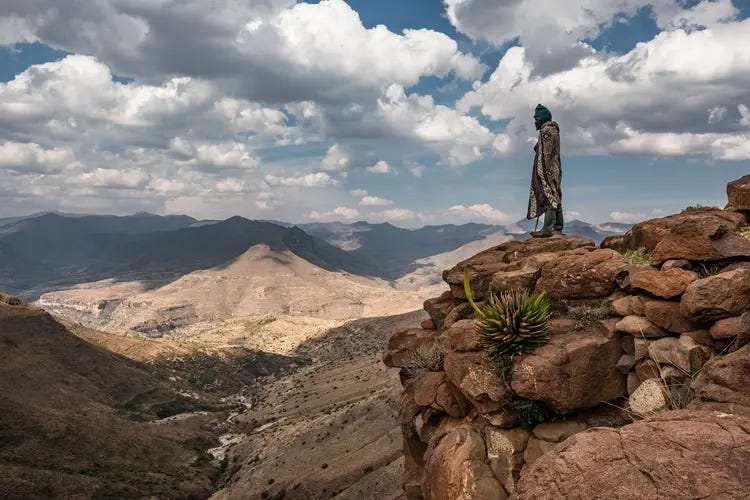
“Brilliance and kindness shine brightest when far from the comfortable centre. Even nature is more generative there too.”
In his recent book “The Edges of the World” (2026), philosopher Charles coveys a sweeping yet illuminating story that gets to the crux of the current polycrisis. And he does that not by getting swept up in the overwhelm of it all, but by honing in on the fundamental nature of our current predicament.
Foster continues this work in his for Aeon Magazine below, building a compelling case for the kinds of mind-shifts necessary to extricate ourselves from our current mess. He argues that creativity, moral virtue, and innovation don’t arise from comfortable, stable centers—they shine brightest at the “edges”: the physical, biological, psychological, and social margins where norms break down and new possibilities emerge.
Embrace the edge!
The cosmos is an edgy place. We are on the far edge of a rapidly expanding Universe, hurtling into nothing. Earth is now further away than it was when you began to read this sentence, from the place where, at the time of the Big Bang, everything started. We have to put it that way, but it is wrong. For at the moment of the Big Bang, neither space nor time existed. They were forged in the explosion.
Everything that has happened in space and time happened on the far fringes. The process of creation and innovation is delegated to the margins.
This sounds poetical. It is. But it is not just poetry. It’s a statement of the way things are and the way things happen in all domains, from evolutionary biology to religion.
They understood this well in the Middle Ages. The abode of the stars – the stellatum – marked the edge of the visible cosmos. Beyond this was the rotating Primum Mobile – the prime mover, whose motion powered everything else. The ultimate edge was the engine driving all Earthly action.
volutionary innovation happens at the edge of genetic orthodoxy, at the edge of an established population, and typically at the edge of a landmass: hence the exuberant biological creativity seen on islands, where new challenges are faced and old inhibitions relaxed. Take the St Kilda archipelago, for instance, in the heaving green sea off the outer isles of Scotland. It once housed a community of embattled farmers and seabird hunters. They were all evacuated in 1930, leaving behind two species of mice, both unique to the islands. The St Kilda house mouse, whose life depended on its coalition with the humans, went extinct within a few years. But the St Kilda field mouse, uninhibited by house mice, cats and humans, blossomed and changed. It doubled in size and became an enthusiastic flesh-eater, prowling the beaches and headlands for dead birds. Edges were fecund on St Kilda – at least for field mice. They always are. Indeed nothing else is.
Sexual reproduction itself is another good example of the creativity of edginess. It involves organisms and their gametes crossing the boundaries of the organism, meeting in the no-man’s land of a fallopian tube, or water, or air, and producing there something differentfrom either of the parents. Sex is a machine for generating novelty. The newly gestated organism bursts across the edge of its mother, becoming fully itself.
Our physiology has evolved to make the most of edges. The phenomenon even has a name: hormesis
Yet there is no security for this or any other organism. It and we are poised always on the cusp of existence, a breath and a heartbeat from annihilation. ‘They [meaning ‘we’] give birth and are astride of a grave, the light gleams an instant, then it’s night once more,’ declaimed Samuel Beckett’s Pozzo in Waiting for Godot (1953) – unnecessarily, for we all know it anyway. I suppose that the secret of happiness – or at least of keeping panic at bay – is to learn to bear, if not enjoy, the ontological vertigo of edge-dwelling.
If we’re edge-people, living in an edgy world, on the edge of death, we might expect our physiology to have evolved to make the most of edges. It has. The phenomenon even has a name: hormesis. Those Victorian schoolmasters who sang the praises of cold baths were right – up to a point. The right sort of stress is good for you. In one fairly typical study, there was a 29 per cent reduction in sickness-related absences from work in people who took up a regime of cold showers.
Stresslessness kills. Sofas are deadly.
The best and truest books, paintings, sculptures and symphonies by edge-people in an edge-world are likely to be celebrations, denunciations or expositions of edges. If they don’t deal with edges, they’re missing the point of it all.
Missing the point is easy. Since the Neolithic there has been an industry devoted to pretending that centres are what life is all about – an industry based, unsurprisingly, in the physical centres called cities. Before then, we were all more or less itinerant hunter-gatherers, wandering in small groups, occasionally coalescing in slightly bigger clans and more occasionally, in some ages and some places (such as Göbekli Tepe, the vast Neolithic temple complex in eastern Türkiye), having bigger, usually cultic, conglomerations. There was nothing then akin to the cities that sprang up in Mesopotamia, where, for the first time, humans could point to a single place and say: ‘That’s where I’m from.’
It’s impossible to exaggerate how big and how bad this change was. Our address had been ‘The Whole World, Scintillating With Potential And Mystery’; now it was ‘A Mud-Walled Pen, Fulminating With Chauvinism And Bureaucracy’. We had been free to go where the seasons, the herds and our preferences led; now we were subject to the tyranny of supply and demand, and at the mercy of a failed harvest.
The Mesopotamian cities of Eridu, Ur and Uruk, which sprouted from about 5500 BCE, were projects of centralisation, conglomeration and consolidation. They and their successors began to articulate a shrill language in which to denigrate edge-dwellers and promote the centrist project. Centres like to get bigger. Their only imperative is growth. They take their philosophy, in other words, from cancer biology.
The Tower of Babel was destroyed, homogenisation confounded, and the edges restored. But not for long
In the Judaeo-Christian tradition, God was unhappy about this development. The first of the creation narratives in the book of Genesis tells how the world was made by separating one thing from another: light from dark; waters from sky; sea from land. My gloss on that account: edges are the web and weave of the universe. God’s insistence on the importance of edges is recalled and codified throughout the Hebrew scriptures. The edges of garments are highlighted by the tzitzit – the tassels dangling from the prayer shawls worn by Orthodox Jews; the edges of the weeks by the choreography of Shabbat; the edges of the Hebrew nation by circumcision, dietary rules and cultural segregation.
Mesopotamian metropolitanism blurred those primordial edges. Recall the Tower of Babel (a ziggurat – a typically Mesopotamian structure), built by people sharing a common language, which reached into God’s own domain, the sky. It was a typical centrist, edge-trashing project, combining homogenisation and hubris. God took action. The tower was destroyed, homogenisation confounded, and the edges restored. But not for long. The Mesopotamians won. Or so it often seems. Metropolises boomed. ‘I am, and who but I?’ declared the centrists, seeking to remake the world in their own image – which meant making everything the same and abolishing the seams between things. Every high street in the world is identical, with its dreary phone shops and sandwich joints. Political and economic power are concentrated in shiny capitals.
But did they truly win? If I’m right, and the cosmos is a dense mesh of edges, and humans are woven of the same edge-stuff as everything, and poised all the time on the cusp of all sorts of edges, would you expect ontology to be trumped by the conceit and self-deceit of men (it’s almost always men – actual or metaphorical) in smoky rooms?
It’s not trumped. Of course, as a matter of mere geography, creativity and the thriving associated with creativity often happen in big cities but, if you look closely, you’ll see that, even there, the thrivers and the creatives are on the edges that course through the centre, becoming ever edgier by grinding against other edgy people there.
That’s my experience. I might sound like the grossest hypocrite. I’m not a desert nomad or a skeletal Franciscan – though I’ve had a traumatic apprenticeship in deserts, wild seas and on ice-caps, mountains and in holes on Welsh hillsides. I’m a well-fed, well-wined, happily married Englishman, writing this in the ancient Oxford college of which I’m a fellow, watched by the portraits of empire-building and stockbroking alumni. But I can tell you that I and all my colleagues here (among whom are some dazzling, tectonic creatives) are gibbering and shuddering with imposter syndrome, wondering when we’re going to be rumbled; wondering when we’re going to be nudged off the edge on which we’re poised. The shuddering is the prerequisite of productivity. The gibbering is the first, and sometimes the final, draft of the articles and the books. The view from the edge is the only view from which we can see anything worth writing about.
Of course, I, like most other humans, am an amphibian. I flop between acknowledging my biological and societal and political and ontological edginess, and flirting with, and sometimes sleeping with, the centre. But I’d like to think that my amphibiousness and my inconsistency don’t disqualify me from noting what I see. I see that the centrists, when they’re being centrists rather than tremulous mortals, harm themselves and me and the rest of the world, and that apparent centres, like this comfortable college, innovate only at the hands of edgy imposters made edgier by the exhilarating insecurity that comes from the company of other edgy imposters.
Rome’s centripetal power drew provincials to itself but they remained emphatically provincial – and so were able to bloom and last
It’s a general principle. It has been clear enough since antiquity. Take Periclean Athens, for instance. At first blush it looks like the epicentre of centres: poised and confident, wearing the crown of the Delian League, its orators the most applauded ever; its playwrights the most accomplished until Shakespeare. And yet its citizens lived in a state of great insecurity, their helmets and spears at the foot of the bed, looking nervously to Sparta in the west and Persia in the east; a city-state of farmers from rural Attica who just happened to have a pied-à-terre below the Acropolis.
Rome likewise: there’s barely a Rome-bred writer of lasting fame. Rome’s centripetal power drew provincials to itself (Virgil from an obscure village near Mantua; Ovid from Sulmo, in the Apennines; Livy in modern Padua; Horace in Venosa, in the province of Basilicata) but they remained emphatically provincial – and so were able to bloom and last.
Byzantium was never on the Bosphorus, but in a Neoplatonic realm far over the edge of this one. Its inhabitants counted angels on pinheads and dealt more in theological arcana than in gold or grain.
Does Renaissance Florence confound the thesis? Its artists, after all, were bankrolled by the Medici – the bankers’ bankers, and apparently the centrists’ centrists. Yet the Medicis patronised the arts, building monasteries and churches, precisely because they believed that, being usurers, they were teetering on the edge of damnation. Supporting Michelangelo might, they thought, keep them from the flames. And, as the art historian Andrew Graham-Dixon argues, the whole of the Renaissance’s rediscovery of the human body – a rediscovery central to the Renaissance project – was kindled by the evangelistic desire of St Francis (an edge-man if ever there was one) to convince the textile workers clustering round the edges of the Tuscan cities that God was on their side because His son had a mutable body like theirs. A celebration of mutability is a celebration of edges.
You’ll see the same in any other realm of life or death.
That last contention will be too much for many. This thesis might seem to be a jumble of category errors. Can we really talk about the edges of an Atlantic island in the same breath as the edge of financial viability, or the edge of life, or the edge of a religious orthodoxy? We can and we must, because we are, as the scholar Iain McGilchrist has swashbucklingly demonstrated in The Matter with Things (2022), inalienably metaphorising mammals. We can’t help it. We can’t think in any other way. Our thoughts – and hence our worlds, and hence our behaviour – are determined by the tyrannical rule of metaphor.
Only dull, sterile states of consciousness prevail in and are promoted by the centre. At some level, we all know this. Why else should we try so desperately to leave our quotidian states of mind with the help of alcohol, sex, coffee, LSD or a run round the block? Many epic creatives have harnessed other states of consciousness more systematically. The surrealist Salvador Dalí went to sleep holding a key which, when he dropped off, fell into a metal bucket, jerking him into the hypnagogic space between waking consciousness and sleep. There he had his seismic visions. Altered states of consciousness, induced by plant hallucinogens or arduous physical exertion, might have powered Ice Age shamanic journeying that gave us the perspective on ourselves that we call modern consciousness. The most paradigm-smashing mathematicians intuit the answer to a conundrum in a way that has little or nothing to do with the linear mental processes beloved of the centre. They then spend the next few decades proving, in a way palatable to the centre, that their intuition was correct. The modernist poet T S Eliotwould have understood. He knew that poetical truths are seen at the corner of the eye – just beyond the edge of ordinary vision.
Risk-takers are attractive because we’re all foundationally edgy, and like attracts like
Religion? The Buddha left behind his royal clan and the luxuries of the court to achieve Enlightenment under a tree. Akhenaten, the heretic pharaoh of the 18th dynasty, who has a fair claim to have invented monotheism, had to move physically out of the cult centre of Thebes and build a wholly new city, Akhentaten, in the middle of absolutely nowhere. The Prophet Muhammad, rejected by the orthodoxy of the day, migrated from Mecca to Medina. Jesus of Nazareth (a very downmarket, provincial place, Nazareth – hence Nathanael’s centrist question: ‘Does anything good come from Nazareth?’) fell foul of the orthodoxies both of Second Temple Judaism and of Rome, and met his death pointedly outside the walls of Jerusalem – a classic edge place where, if the Christians are right, the whole cosmos was redeemed.
Adventure? Not in Whitehall or Wall Street, but in the sticks. The archetypal adventurers are the Arthurian knights. Remember how Sir Gawain and the Green Knight begins? In a pastiche of centrism: the court at Christmas, soft, luxurious and sticky with sweet meats. The adventure starts when the court is left behind, and is consummated in the most obscure place of all: ‘Nobbut a cave’, as the Gawain poet puts it. Adventurousness is attractive: risk-takers get more attention, more money and more sex. They’re attractive because we’re all foundationally edgy, and like attracts like.
Ethics? Isn’t the greatest generosity seen in the hospitality of desert nomads who have nothing? The greatest nobility and altruism in the dying? The greatest forgiveness in those who have most to forgive? ‘As a matter of fact,’ observed Richard Holloway, the former Bishop of Edinburgh, ‘moral change always comes from those who are out ahead of the institution, never from those in charge of it.’
The centrists hate this sort of talk, for aren’t they – well – the centre? Where it’s all at. The wellspring. Over the millennia, they have devised cunning strategies in the hope of suppressing edge-people, neutralising edginess itself, and consolidating the centre’s grip on our aspirations, our shops and our ontologies.
They don’t baulk at violence, but since violence can spawn edges – and edge-attributes such as courage and self-sacrifice – they prefer more predictable methods.
There’s an ascending scale. First they try to persuade edge-people of the error of their ways. It rarely works, for it means trying to convince people that they’re something that they’re not.
When this fails, the centrists turn to their next tactic: assimilation. This needn’t, and usually doesn’t, involve getting the subject to change her mind about edginess, but instead relies on a whispered insistence that resistance is hopeless (or will be too arduous) and, most effectively, on the fear of missing out; the deadly sweet pull of the inner circle. The process is best described in the most urgently prescient book of our age, C S Lewis’s That Hideous Strength(1945), a novel that charts the journey of a young, gullible academic, Mark Studdock, to the deliciously dangerous centre of an infernal conspiracy. He doesn’t want to be there; he gets no joy from it. But agency withers and joy is irrelevant in the gravitational field of the centre.
Siberian shamans, derided by the Soviets for saying they could fly, were hurled out of helicopters to shouts of ‘Prove it!’
If this doesn’t work, the next stage is denigration and the cold shoulder. The biologist Rupert Sheldrake insolently suggested, in his book A New Science of Life (1981), that perhaps canonical science might not have the whole answer to questions of causation, and that another model might have something to contribute. The book was, roared Sir JohnMaddox, the then-editor of the eminent journal Nature, ‘the best candidate for burning there has been for many years.’ It should be, he later added, ‘condemned in exactly the language that the Pope used to condemn Galileo, and for the same reasons. It is heresy.’ Just think of the insecurity behind that comment. Sheldrake, whose only sin was to take seriously the Enlightenment’s insistence that everything should be questioned, was banished from the Academy, to conduct his quietly audacious experiments mostly from a bedroom in Hampstead.
Note that Sheldrake persisted in being edgy in that bedroom. Most edge people do. And when they do, there’s nothing that the enraged centre won’t try. Siberian shamans, who lived on and constantly shuttled across the edges of consciousness and category, were derided by the Soviets for saying that they could fly, and hurled out of helicopters to shouts of ‘Prove it!’ Unclassifiable, address-less people in all ages, hated and feared by the centre, have been hunted down, speared, gassed, and written out of history.
None of the centre’s strategies will work – or work for long. Pity the poor centre – so puffed up that it can’t see beyond itself. Missing out on so much. So mistaken about how the world is made and what sort of creatures humans are. Fated to stand fuming and impotent, like Canute on the beach, as the advancing edge of the sea threatens to overwhelm it. Doomed by the laws of physics and metaphysics. For the apotheosis of the centre is of course the black hole, whose immense gravitational force destroys everything drawn into its orbit.
To survive and thrive, you have to act as your constitution and your surroundings decree. That means acknowledging that you’re an edge person in an edgy world, resisting, for all that is sacred, that pull towards the centre. The centre will fight tooth and nail to stop you acknowledging it.
‘The quest of the Inner Ring will break your hearts unless you break it,’ wrote C S Lewis. ‘But if you break it, a surprising result will follow.’ Indeed it will.
Remarkable essay, poignantly highlighting how creativity and emergence happens at the edges. That is precisely the opportunity (and tragedy) that collapsing into the back loop offers.