
Why Collapse Is Inevitable
by Ernesto Van Peborgh
A clear-eyed look at why some inherited worldviews make decline unavoidable.
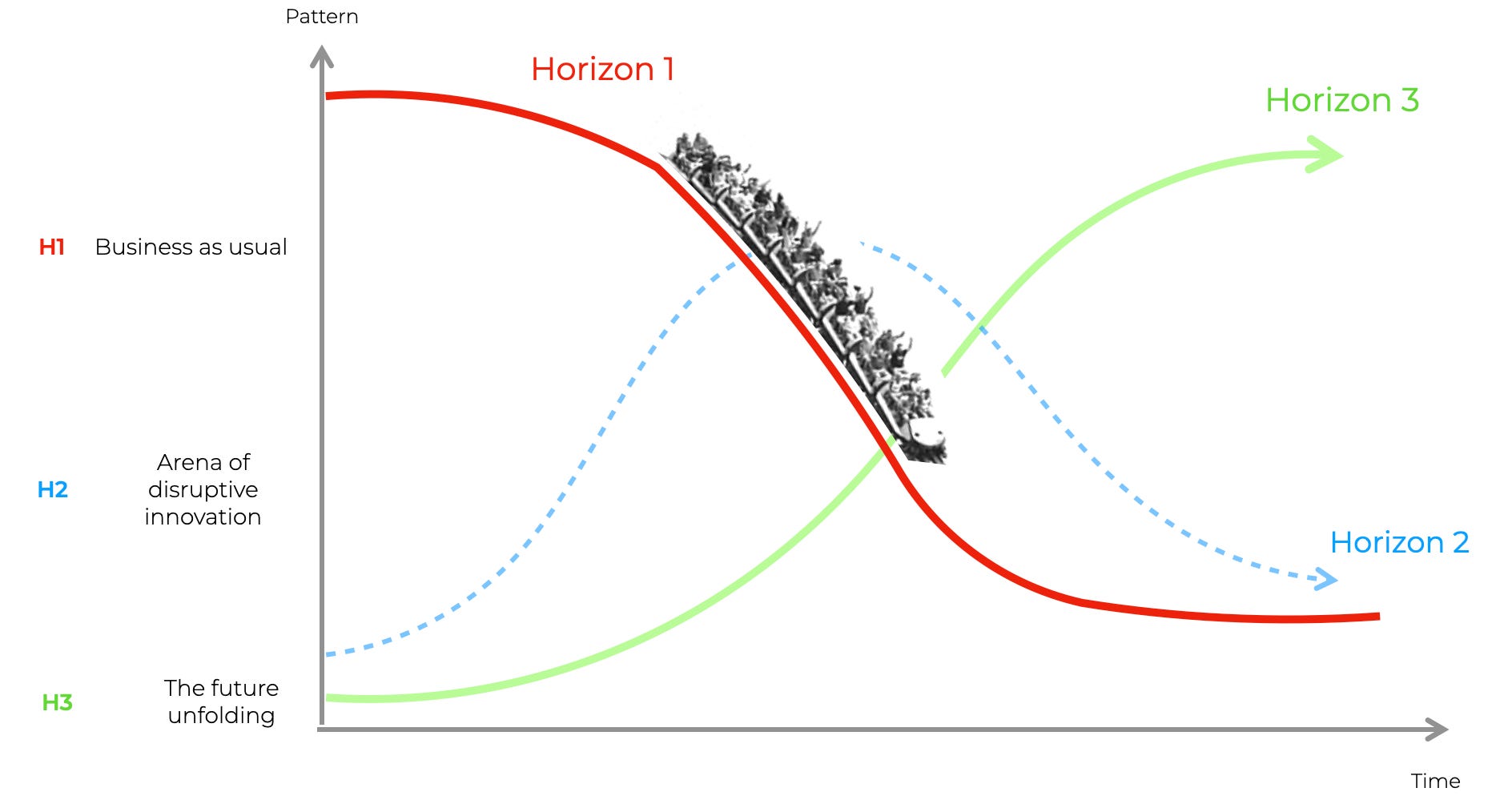
The Three Horizons model shows how the dominant system (Horizon 1) declines, disruptive innovations emerge (Horizon 2), and a new, life-aligned future takes shape (Horizon 3), gradually replacing what no longer serves.
We are in a collapsing curve in our civilizational moment: Horizon 1, the familiar world, is carrying us like a crowded rollercoaster into decline. Horizon 2 disrupts with scattered flashes of innovation. And beneath it all, Horizon 3 rises — quiet, green, emergent — the future already unfolding, asking us to shift our allegiance from collapse to possibility.
Where We Left Off
In the The Architecture of Paradigms, Part I of this series, we explored the five paradigms and the archetypes they awaken — showing that each shift is not just intellectual but a quiet death of the self shaped by the old worldview.
But knowing how paradigms change is only half the story.
Part II turns outward — to the systems, constraints, and ecological realities that no belief can negotiate with. If Part I asked,
“Why is paradigm change psychologically hard?”
Here in Part II we ask:
“Why is paradigm change now unavoidable?”
This is not a descent into despair but into coherence, a clear look at why the first three paradigms — Conventional, Green, Sustainable — cannot carry us into the future.
Here begins the terrain where the comfort of story ends, and the clarity of reality begins.
When the Pattern Finally Reveals Itself
There are truths we resist until they gather enough weight to press through the thin membrane of denial.
And once they do, they do not ask for permission.
They rearrange the architecture of our inner world, whether we are ready or not.
For decades we have tried to bargain with reality.
We called it progress.
We called it development.
We called it sustainability.
But these were only words — thin veils stretched across an unmistakable pattern:
A civilization built on extraction will eventually extract itself out of a future.
And now, as the world begins to tremble under the accumulated strain of its own design, a deeper clarity emerges — painful, sober, proportionate:
Collapse is not a prophecy.
Collapse is the continuation of the current trajectory.
Collapse is the inevitable consequence of the first three paradigms.
This is what we begin to see with collapse awareness — not panic, not fatalism, but coherence.
The world suddenly makes sense in the way a single puzzle piece makes sense once you’ve seen the box.
Let us name the pieces.
1. Collapse Is the Result of Asking a Finite Planet to Feed an Infinite Story
For fifty years we tried to defy the most basic arithmetic in the universe:
Finite planet + Exponential growth = Eventual systemic breakdown.
This is not ideology.
This is not pessimism.
This is physics.
GDP must rise every year.
Corporate profits must increase.
Production must expand.
Consumption must accelerate.
Credit must grow.
Debt must outrun debt.
Every year, the economic system demands more energy, more materials, more throughput, more pressure.
But the planet does not expand.
The biosphere does not scale.
Living systems do not obey the logic of compound interest.
Growth on a finite substrate always ends the same way:
overshoot → depletion → collapse.
We are not the first civilization to discover this.
Only the first to globalize it.
2. We Have Breached at Least Seven Planetary Boundaries — Possibly Irreversibly
The Earth is not fragile.
It is bounded.
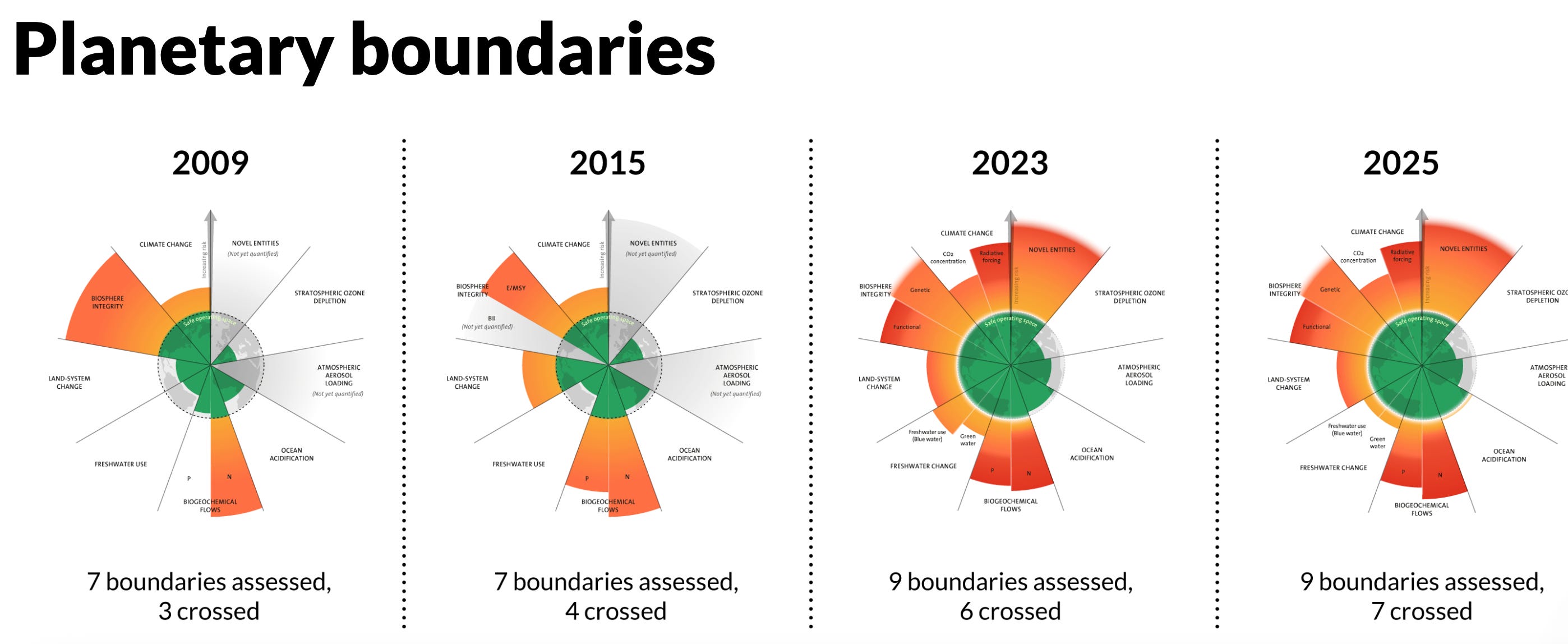
A living system with load-bearing beams.
And we have cracked nearly all of them:
climate regulation
biodiversity integrity
biosphere productivity
freshwater stability
chemical pollution
nitrogen/phosphorus cycles
ocean acidification
soil fertility
These are not “environmental issues.”
They are the scaffolding of the biosphere.
When those boundaries crack, civilization does not gradually adapt — it loses its structural support.
You cannot green-innovate your way around planetary boundaries.
You cannot negotiate with them.
You cannot brand your way past them.
The Earth does not read sustainability reports.
3. The First Three Paradigms Are Different Versions of the Same Fatal Assumption
Conventional, Green, Sustainable.
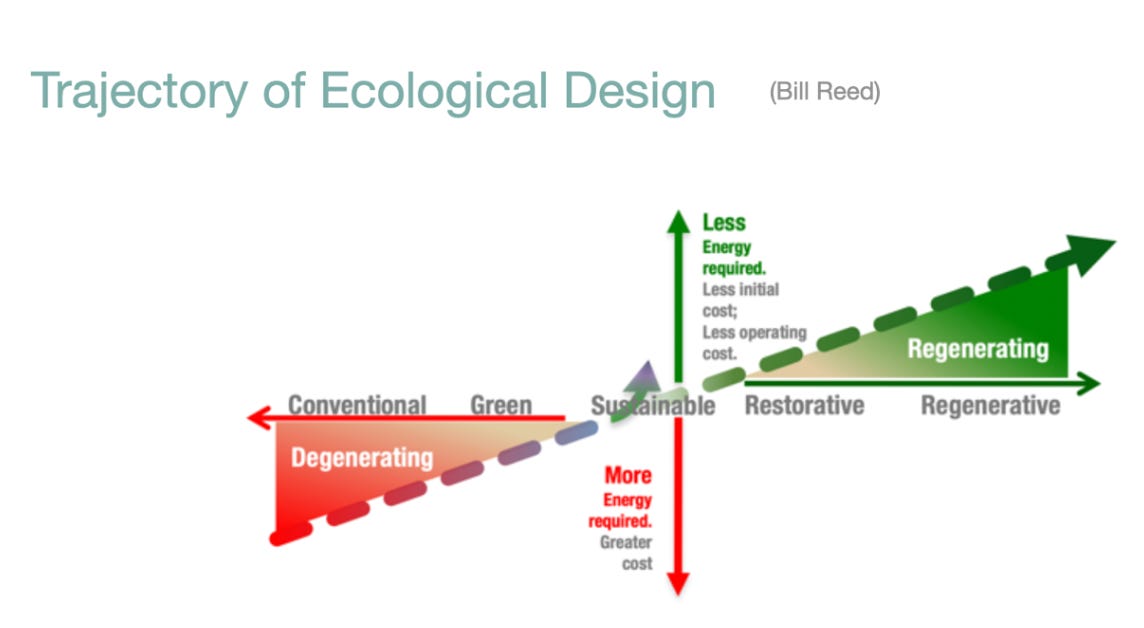
Bill Reed’s trajectory shows design evolving from degenerating (Conventional–Green) to neutral (Sustainable) to life-enhancing (Restorative–Regenerative), reducing energy while increasing vitality.
Three worldviews with different aesthetics, but the same metabolic signature:
The world is a supply to be managed.
Conventional extracts at full speed.
Green extracts more efficiently.
Sustainable extracts slowly and politely.
Different ethics, same ontology.
And an ontology that sees the world as resource is, by design, incompatible with the laws of living systems.
This is why collapse is not moral
— it is systemic.
You cannot optimize your way out of a worldview that is devouring the life-support system beneath it.
4. Fossil Fuels Are Not an Energy Source — They Are a One-Time Inheritance
Eighty percent of our planetary metabolism still runs on ancient sunlight — oil, gas, coal.
Not because we lack alternatives, but because there is no substitute for the density, portability, and EROI (energy return) of fossil fuels.
Solar panels require mining.
Wind turbines require smelting.
Batteries require global supply chains.
All of these require fossil fuels — for extraction, refinement, transport, installation, and replacement.
Renewables are not an alternative industrial substrate.
They are an extension of the fossil fuel system.
As net energy declines, complexity declines.
As complexity declines, societal functions contract.
As contraction accelerates, the system shifts from expansion to breakdown.
That breakdown is collapse.
5. The Global Food System Is a Fossil-Fuel System Wearing a Biological Mask
Modern agriculture is not a biological process.
It is a petrochemical process using plants as intermediaries:
diesel for tractors
natural gas for fertilizer
pesticides derived from fossil carbon
industrial irrigation pumping depleted aquifers
monocultures collapsing soil microbiomes
global shipping networks powered by bunker fuel
We are eating oil, gas, and phosphate.
Transformed into calories through soil depletion.
We destroy the fertility of the future to feed the present.
You cannot sustain this system.
You can only slow its collapse.
6. Consumption Is Not a Vice — It Is a Psychological Coping Mechanism
We often believe consumerism is driven by greed, convenience, or habit.
But modern psychology suggests something more unsettling:
Consumption regulates existential fear.
Growth gives us an illusion of continuity.
Shopping eases the anxiety of mortality.
Economic expansion displaces the terror of impermanence.
In other words:
We consume because we are existentially unanchored.
This means the extractive economy is not merely a material problem —
it is an emotional one.
A cosmological one.
You cannot solve overshoot by telling people to consume less.
That is asking them to relinquish their primary mechanism for buffering existential fear.
Collapse is not technical.
It is psychological.
7. Complexity Is Becoming Too Expensive to Maintain
Civilization is a vast energy-processing organism — millions of nodes in motion, all dependent on invisible flows of energy, materials, and coordination.
But complexity has a cost.
And that cost rises over time.
Roads, hospitals, schools, digital networks, financial infrastructure —
all require continuous energy, materials, and maintenance.
The moment net energy declines, the system loses the ability to maintain itself.
History teaches us: civilizations do not “fail.”
They simplify.
They shed complexity.
They shed bureaucracy.
They shed institutions.
They shed illusions.
This simplification is what we call collapse.
8. Sustainability Is a Beautiful Idea That Stabilizes the System That Must End
Let us be honest: Sustainability is the ceiling of the old story.
“Sustainable development” means:
“Let this civilization endure a little longer.”
But the current civilization is the crisis.
Its continuation ensures collapse.
Sustainability is extraction at a slower pace.
It is amplifying harm with good intentions.
It is hospice care for a worldview that has passed its ecological expiration date.
And once you see that, you cannot unsee it.
9. Our Institutions Are Designed for a World That No Longer Exists
We are facing nonlinear planetary risks with:
Nervous systems calibrated for survival, not complexity
Medieval designed institutions
20th-century economic logic
and 21st-century planetary-scale consequences
Our governance models optimize for elections, not ecosystems.
Our markets optimize for short-term extraction, not long-term resilience.
Our cultures optimize for continuity, not contraction.
You cannot run a multi-species planet on a monocultural economic operating system.
It breaks.
It is breaking.
10. Collapse Awareness Is Not Doom — It Is the End of Denial
Collapse awareness is not a psychological disorder.
It is a perceptual upgrade.
It is the moment you stop bargaining with impossible mathematics and inherited myths.
You see:
we are in ecological overshoot
we rely on declining net energy
planetary boundaries are breached
complexity is becoming unsustainable
growth is incompatible with physics
sustainability will not save us
the extractive paradigm is self-terminating
restoration is necessary but insufficient
regeneration is the only viable path
collapse is not the end of the world, but the end of one worldview
Collapse awareness is the death of the old narrative.
Collapse acceptance is the birth of a new one.
The Transition From Fear to Proportion
Once the initial fear settles, something remarkable happens:
Collapse stops looking like doom and starts looking like coherence — the biosphere withdrawing credit from an overdrawn species and inviting us into humility again.
The Earth is not ending.
The extractive story is.
Collapse is not the apocalypse.
It is metabolization.
It is composting.
It is planetary feedback revealing the next evolutionary demand.
And the invitation hidden inside collapse is simple:
Live in alignment with life’s operating principles — or live with the consequences of violating them.
Awareness is the doorway.
Acceptance is the crossing.
Regeneration is the path on the other side.
Source:
